Best Automotive Trade School: Your Guide
Table of Contents
- What Makes a Quality Automotive Trade School
- Certificate III in Light Vehicle Mechanical Technology: Duration and Pathways
- Automotive Apprenticeship Requirements and Getting Started
- Government Subsidised Trade Training: How to Access Support
- Specialisations: Electric Vehicles and Advanced Certifications
- Hands-On Workshop Training vs Theory: What You’ll Actually Learn
- Career Outcomes and Post-Graduation Opportunities
- Conclusion
- Frequently Asked Questions
Last Updated: September 27, 2026
What Makes a Quality Automotive Trade School
A quality automotive trade school combines hands-on practical training with industry-recognized qualifications. The key differentiators: trainers with real workshop experience, facilities that mirror actual workplace conditions, and curriculum current with modern vehicle technology.
Many students assume all automotive trade schools teach the same content, they don’t. A school still teaching carburettor repair while the industry has moved to fuel injection systems leaves you unprepared. A quality automotive trade school updates its curriculum to include electric vehicles, hybrid systems, and modern diagnostic equipment.
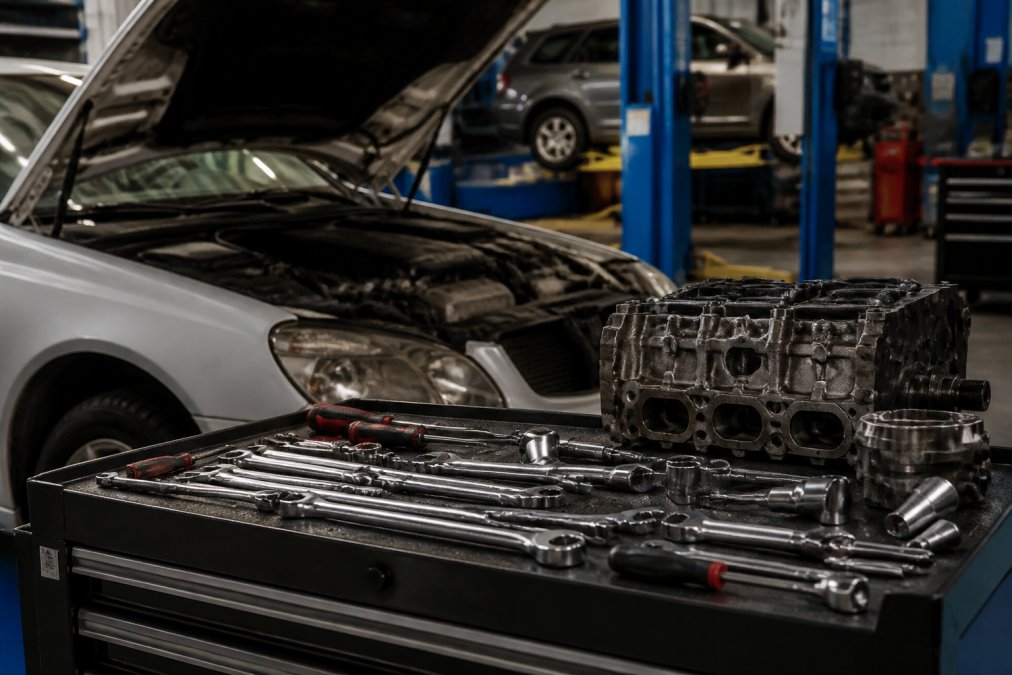
Swann College, a Registered Training Organisation with campuses in Adelaide and Sydney, structures its approach around real-world relevance. The facility mirrors an actual automotive workshop, so your first job won’t feel foreign, you’ll already know how to organize a workspace and manage multiple tasks.
When evaluating providers, ask: Do trainers work in the industry? Are students working on actual vehicles or simulations? Is the facility accredited? Does the provider have formal partnerships with industry groups?
Certificate III in Light Vehicle Mechanical Technology: Duration and Pathways
Certificate III in Light Vehicle Mechanical Technology is the foundation qualification for most automotive mechanics in Australia. Full-time study typically takes 12-18 months; part-time options may extend to 24-36 months.
The qualification is nationally recognised, giving you flexibility to relocate for work opportunities across Australia.
Pathway structure varies: some providers separate theory and practical into blocks, while Swann College integrates both throughout the course. You learn a principle, apply it immediately in the workshop, then consolidate understanding through assessment.
Most providers require Year 10 completion or equivalent.
Swann College delivers nationally accredited courses, so you may qualify for subsidised training depending on your circumstances.
Automotive Apprenticeship Requirements and Getting Started
An apprenticeship is the most common pathway into automotive mechanics. You’re employed by a workshop while completing qualifications, earning a wage and gaining real-world experience. The trade-off: apprenticeships take 3-4 years and require balancing work and study.
To start an apprenticeship, you need a host employer to sponsor you.
Formal requirements are minimal: Year 10 completion and basic numeracy and literacy. Employers assess reliability, attitude, and willingness to learn.
Apprenticeships involve three to four days per week at your employer’s workshop and one to two days at a training provider. You’re earning while learning, but managing two commitments requires strong time management.
Government subsidised apprenticeships reduce financial burden significantly. Your employer may contribute to training costs, and you receive a wage throughout, unlike full-time study, where you pay fees and earn nothing for 12-18 months.
By completing your apprenticeship, you’ve spent 3-4 years in a real workshop, so your first job isn’t your first day learning culture and systems.
Government Subsidised Trade Training: How to Access Support
Government subsidised trade training reduces barriers to entry. The government contributes to training costs through apprenticeship subsidies and, in some cases, direct support for full-time vocational students.
The most accessible pathway is through an apprenticeship. Both you and your employer benefit from government support: your training fees are subsidized, and your employer may receive subsidies for taking on an apprentice.
To access this support, you’ll typically work through your training provider. Swann College, as a Registered Training Organisation, can guide you through the application process and confirm your eligibility. The requirements usually include being an Australian citizen or permanent resident and having secured an apprenticeship position.
Some states offer additional support for full-time vocational students, particularly in priority industries like automotive trades. Eligibility varies, so it’s worth checking your state’s training authority website for current offerings.
The key is to start the conversation with your training provider early. Don’t assume you’re ineligible because of age, employment status, or prior education. The system is designed to be accessible, and providers like Swann College have experience navigating eligibility criteria for different student circumstances.
Specialisations: Electric Vehicles and Advanced Certifications
The automotive industry is shifting toward electric and hybrid vehicles, and training providers are catching up. If you’re choosing an automotive trade school now, specialization in electric vehicle technology is becoming increasingly important for job security.
A quality automotive trade school will offer EV specialization either as part of the core Certificate III curriculum or as an additional module. The specifics vary, but the principle is the same: you need to understand how modern vehicles work, not just traditional internal combustion engines.
Advanced certifications beyond Certificate III include Certificate IV in Automotive Technology and Diploma-level qualifications. These are typically pursued after you’ve completed your initial apprenticeship or full-time study. A Certificate IV focuses on supervisory skills, advanced diagnostics, and specialization in areas like diesel mechanics, motorsport repair, or heavy commercial vehicle maintenance.
Automotive air conditioning is another common specialization. Many workshops require technicians to hold a specific qualification in this area due to regulatory requirements around refrigerant handling. If you’re considering this path, check whether your chosen provider offers this module as part of their program or as a standalone short course.
Swann College’s curriculum is developed in association with the Institute of Automotive Mechanical Engineers, which means the content reflects current industry practices. This partnership ensures that specializations like EV training aren’t theoretical exercises, they’re aligned with what employers actually need.
The decision to pursue a specialization early depends on your career goals. If you know you want to work in EV diagnostics or heavy vehicle maintenance, choosing a provider that offers strong specialization training saves you time later. If you’re still exploring, a broad Certificate III with the option to specialize later is perfectly valid.
Hands-On Workshop Training vs Theory: What You’ll Actually Learn
The split between hands-on workshop training and classroom theory is where most automotive trade schools reveal their true quality. In theory, they should be balanced. In practice, many providers lean too heavily toward one or the other.
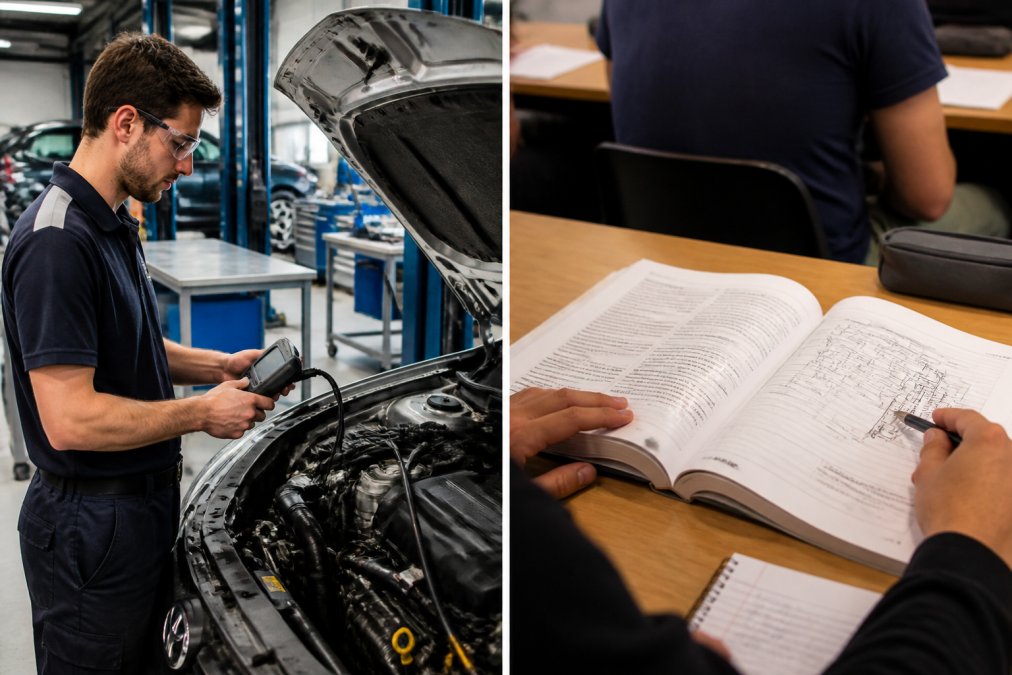
Classroom theory teaches you the principles: how fuel injection systems work, why spark plugs wear out, what electrical circuits do. This knowledge is essential. You can’t diagnose a problem you don’t understand. But theory alone leaves you unprepared for the reality of a workshop: a customer’s 2024 sedan with a fault code that doesn’t match the textbook, a time-sensitive repair during a busy Saturday, or a piece of equipment that behaves differently from the training manual.
Hands-on workshop training is where you actually develop the skills that employers pay for. You learn to use diagnostic equipment, interpret results, and make decisions under time pressure. You discover which tools work best for different jobs, how to organize your workspace for efficiency, and how to communicate with customers about repairs.
The best automotive trade schools integrate these throughout the course. You learn a principle in the classroom, then immediately apply it in the workshop the same week. This reinforcement is critical for retention. Separating theory and practical by months means you’re relearning the principle when you finally get to apply it.
Swann College’s workshop facility is designed to mirror real working conditions. This isn’t a training environment that’s been simplified for learning, it’s a genuine workshop where you’re learning the actual job, not a sanitized version of it. The difference matters. When you transition to employment, you’re not experiencing culture shock because you’ve already worked in a similar environment.
Ask any provider directly: What percentage of your course is hands-on versus theory? How often do students work on actual vehicles versus simulations?
Career Outcomes and Post-Graduation Opportunities
Completing an automotive trade qualification opens multiple career pathways. The most direct route is employment as an automotive mechanic in a workshop, dealership, or fleet maintenance operation. These roles are consistently in demand across Australia, and qualified mechanics are relatively easy to place in employment.
Conclusion
Choosing the best automotive trade school means prioritizing hands-on workshop training delivered by experienced practitioners, ensuring the curriculum includes modern vehicle technology like electric vehicles, and confirming that the provider is a Registered Training Organisation with nationally accredited qualifications. The decision shapes not just your initial training but your entire career trajectory in the automotive industry.
Frequently Asked Questions
What’s the difference between a Certificate III and Certificate IV in Light Vehicle Mechanical Technology?
Certificate III in Light Vehicle Mechanical Technology is the foundational qualification for automotive mechanics, covering core diagnostic and repair skills and typically taking 12–18 months full-time. Certificate IV builds on this, adding supervisory and advanced technical knowledge, usually taking an additional 12 months. Certificate IV holders often progress to team lead or workshop management roles. Both are nationally recognised qualifications that meet industry standards and employer requirements.
Are there government-subsidised automotive courses available?
Yes. Government-subsidised trade training is available through various state and federal programs designed to support skill development in essential trades. Eligibility depends on factors like age, employment status, and prior qualifications. Contact your state training authority or speak directly with a registered training organisation to confirm which courses qualify for subsidy in your area and what support you may be eligible for.
How do I know if an automotive trade school’s trainers actually understand modern electric vehicles?
Look for trainers with current industry experience and formal qualifications in automotive mechanics. Ask whether the school’s curriculum is developed with industry bodies like the Institute of Automotive Mechanical Engineers, and whether trainers regularly update their knowledge. Many quality providers now offer dedicated EV and hybrid specialisation modules. Request details about trainer credentials and industry involvement before enrolling.
Will a qualification from an automotive trade school help me get permanent residency if I’m an international student?
A nationally accredited automotive qualification can support migration pathways, as the automotive trade is on various skilled occupation lists. However, migration eligibility depends on many factors including your visa type, points, employer sponsorship, and current policy settings. Work with a migration agent and your training provider to understand how your specific qualification aligns with current skilled migration requirements.